How to Convert Any Recipe to Egg-Free
How to Convert Any Recipe to Egg-Free
Egg allergy is one of the most common food allergies in the world — especially in children, where it sits second only to milk. For families managing a child’s allergy, “just leave the eggs out” is not a casual swap. It is the difference between a safe birthday cake and an emergency room trip. Even for adults with a milder chicken-egg sensitivity, finding eggs hidden in pasta, breaded chicken, or a glazed pastry can turn a normal week of eating into a minefield.
The audience for egg-free cooking is bigger than most people realize. Allergy families. Adults who have developed an egg sensitivity later in life. Vegans, who avoid eggs by definition. People managing high cholesterol on doctor’s orders. Religious observers who avoid eggs at certain times. Anyone cooking for a guest who falls into one of those buckets. If you are reading this, you probably belong to one of those groups, or you cook for someone who does.
Here is the catch that makes egg-free baking harder than dairy-free: eggs do not do one job in a recipe. They do at least eight, often several at the same time. A single egg in a chocolate cake might be binding the batter, contributing structure as it sets, providing moisture, and helping the cake brown — all at once. To reliably convert a recipe to egg-free, you have to figure out which jobs the eggs are doing in that specific recipe, then pick a substitute that fills those exact roles. A flax egg works beautifully in cookies and ruins meringue. Aquafaba is magic for mousse and useless for binding meatballs. There is no universal egg replacer.
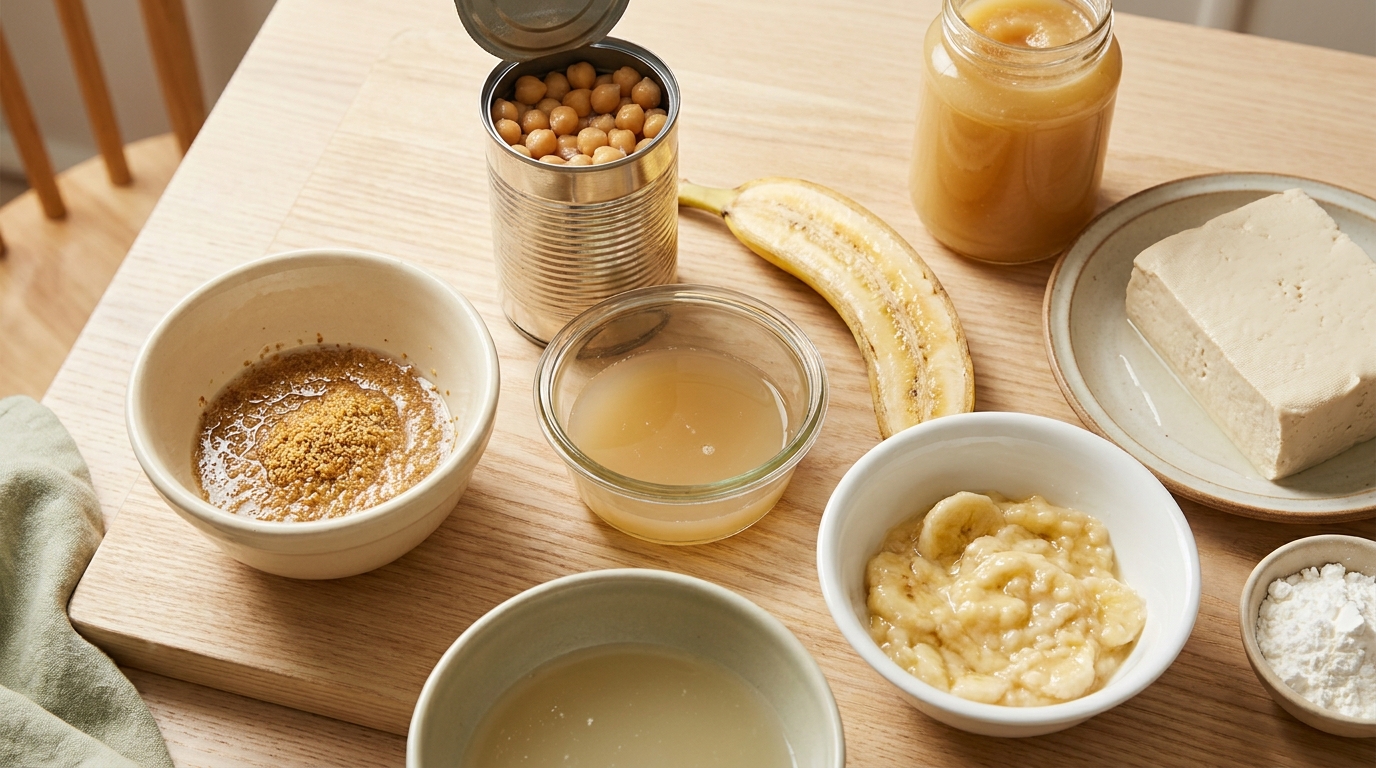
This guide will give you the working knowledge to make any recipe egg-free with confidence — from a four-egg chiffon cake to a pan of meatballs to your Saturday morning pancakes.
Fundamentals: What Eggs Actually Do in Cooking
Before you can substitute an egg, you need to know what it is doing. Eggs are biological packages designed to grow a chick — which means they contain a remarkable mix of proteins, fats, water, and emulsifiers. That chemistry is why they are so versatile, and why no single substitute matches all of their behaviors.
Here are the eight functional roles an egg can play. Most recipes use eggs for two or three of these at once.
1. Binding. Eggs glue ingredients together. Think meatballs, veggie burgers, crab cakes, meatloaf — anything that needs to hold its shape on a plate. The proteins in the egg coagulate during cooking and grab onto everything around them.
2. Leavening. Eggs lift baked goods in two ways. Whipped or beaten eggs incorporate air bubbles directly into a batter, and the water inside the egg turns to steam in the oven, expanding those bubbles further. In a sponge cake or chiffon, the eggs are doing most of the rising.
3. Moisture. A large egg is roughly 75% water by weight. In a recipe with a small ingredient list — pancakes, quick breads, muffins — that water is a meaningful chunk of the total liquid.
4. Structure. Egg proteins set when heated, forming a network that gives baked goods their crumb. This is why a custard goes from liquid to sliceable, why a cake holds its shape after rising, and why a souffle stands tall (briefly).
5. Emulsification. Egg yolks contain lecithin, a powerful emulsifier that lets fat and water mix smoothly. Without it, you cannot make traditional mayonnaise, hollandaise, or a smooth chocolate ganache the same way.
6. Aeration and foaming. Egg whites whip into a stable foam that holds enormous amounts of air — that is the entire premise of meringue, mousse, marshmallow, angel food cake, and souffles. The proteins in the white unfold and trap air in a way few other ingredients can match.
7. Browning and color. An egg wash brushed on pastry creates that glossy, golden top crust. The proteins and sugars in the egg drive the Maillard reaction at high heat, producing color and a slight crisp.
8. Thickening. Yolks added to a hot liquid thicken it without making it grainy — that is what turns milk and sugar into custard, lemon juice and sugar into lemon curd, and a sauce into a velouté.
The substitution rule for egg-free baking and cooking is simple to state and harder to apply: identify which job (or jobs) the egg is doing in your recipe, then choose the substitute built for that job. The rest of this guide walks through each role and the substitutes that actually work for it.
Egg Substitution by Function — A Detailed Guide
Binding
Binding is the easiest job to replace. You need something sticky, hydrated, and willing to coagulate or gel as it heats.
- Flax egg. 1 tablespoon ground flaxseed plus 3 tablespoons warm water, stirred and rested for 5 minutes until it gels. This is the workhorse of egg-free baking — neutral flavor, reliable bind, mild nutty undertone. Best in cookies, muffins, pancakes, veggie burgers, and meatballs.
- Chia egg. 1 tablespoon chia seeds plus 3 tablespoons water, rested 5–10 minutes. Slightly stronger gel than flax. Works great in dense baked goods, energy bars, and granola clusters. Whole chia leaves visible specks; ground chia blends in.
- Mashed potato. A few tablespoons of cooked, mashed potato bind savory mixtures (latkes, croquettes, veggie patties) without adding sweetness or strong flavor.
- Oat flour or rolled oats. A couple of tablespoons absorb moisture and bind ground meat or veggie mixtures. Particularly good in meatloaf and veggie burgers where you want a slightly heartier texture.
Leavening
If the recipe leans on eggs for rise, you need something that produces gas — usually carbon dioxide from a chemical reaction.
- Baking soda + acid. 1 teaspoon baking soda plus 1 tablespoon vinegar (white, apple cider) or lemon juice replaces one egg’s leavening contribution. The reaction is immediate — add it last and get the batter into the oven quickly.
- Commercial egg replacer. Bob’s Red Mill, Ener-G, and Orgran all sell powdered blends that combine starches and leaveners. Mix with water per the package instructions. These are formulated specifically to fill the leavening-and-binding role.
- Club soda. Substituting 1/4 cup of club soda for an egg adds carbonation that helps batters lift. Best in pancakes, waffles, and light cakes where you want a delicate crumb.
Moisture
Pure water swaps work in a pinch, but recipes designed around eggs usually expect a bit of body and sugar along with the moisture.
| Substitute | Amount per egg | Best for |
|---|---|---|
| Unsweetened applesauce | 1/4 cup | Muffins, brownies, loaf cakes |
| Mashed ripe banana | 1/4 cup (about half a banana) | Pancakes, banana bread, sweet quick breads |
| Pumpkin or sweet potato puree | 1/4 cup | Spiced cakes, fall baking, brownies |
| Silken tofu (blended smooth) | 1/4 cup | Dense cakes, brownies, custards |
Each of these adds flavor along with moisture — banana and applesauce both bring sweetness, pumpkin brings earthiness, tofu is the most neutral of the bunch.
Structure
When a recipe needs an egg to set the crumb (think custard-style baked goods, dense cakes, quiche), you need a protein source that can coagulate or at least hold a network together.
- Silken tofu, blended smooth. 1/4 cup per egg. The soy proteins set when heated, mimicking egg coagulation. This is the secret to a believable vegan quiche or crustless tart.
- Commercial egg replacer. The starch-based blends do real structural work in cakes and muffins. For best results, hydrate them per package directions and add to the batter alongside the wet ingredients.
- Combinations. For multi-egg recipes, combine 1 flax egg (binding) with 1 tablespoon of cornstarch dissolved in water (structural support) for a more complete substitute.
Emulsification
This is where egg yolks shine, and where substitutions get tricky. You need something with natural emulsifying compounds.
- Aquafaba. 3 tablespoons replaces a whole egg or about 1.5 tablespoons replaces a yolk. The dissolved chickpea proteins behave a lot like egg proteins in mayo and hollandaise-style sauces.
- Silken tofu blended with a splash of oil. Lecithin in soy makes tofu a quiet emulsifier — useful in creamy dressings and dips.
- Mustard plus soy lecithin. A teaspoon of mustard contains natural emulsifiers; adding a pinch of soy lecithin granules boosts the effect. This is the pro move for egg-free aioli or vinaigrettes that need to stay together.
Aeration and Foaming
This is the role most home cooks assume is impossible without eggs. It is not — but the answer is almost always aquafaba.
- Aquafaba. 3 tablespoons whipped to stiff peaks replaces 1 egg white. Add 1/4 teaspoon cream of tartar per 3 tablespoons of aquafaba for stability. Whipping takes 5–10 minutes with a stand mixer or hand mixer at high speed. Use it for meringue, pavlova, mousse, marshmallow fluff, macarons, and angel food–style cakes.
For cakes that rely heavily on whipped whites for lift (chiffon, angel food), aquafaba alone may not give you the same volume. Combine whipped aquafaba with extra baking powder and a starch-rich flour blend to compensate.
Browning and Color (the egg wash)
Egg wash is purely decorative — it gives bread, pastry, and pies their golden, glossy top. The good news: a few simple substitutes get most of the way there.
| Egg wash substitute | How to use | Result |
|---|---|---|
| Maple syrup + plant milk (1:1) | Brush a thin layer | Golden, slightly sweet, glossy |
| Melted vegan butter | Brush before and after baking | Rich golden color, soft sheen |
| Neutral oil + sugar | Brush oil, sprinkle sugar | Crisp, sparkly top — great for sweet pastries |
| Plant milk alone | Brush with a pinch of salt | Light golden, no shine |
For savory breads and pretzels, a quick baking soda dip before baking gives the deepest color of any of these.
Thickening
When eggs thicken a custard or curd, they are doing something starches can replicate well — though the texture is slightly different.
- Cornstarch slurry. 1 tablespoon cornstarch mixed with 2 tablespoons cold water per egg. Whisk into the hot liquid and cook gently until thickened. Best for pastry cream, lemon curd, and pudding-style desserts.
- Arrowroot. Similar ratio to cornstarch, but produces a glossier, more delicate set. Do not boil aggressively or it will thin out.
- Kuzu (kudzu starch). A traditional Japanese thickener that produces a clean, neutral set. Use about 1 tablespoon per egg, dissolved in cold water before adding.
The texture of starch-thickened “custard” is a touch silkier and less rich than the egg version — adding a tablespoon of coconut cream or a small amount of nut butter can restore some of the body.
The Aquafaba Revolution
If there is one ingredient that genuinely changed egg-free baking in the last decade, it is aquafaba — the slightly viscous liquid you pour out of a can of chickpeas. For years, that liquid went straight down the drain. Then, around 2014, a French chef discovered it could be whipped into something that behaves almost exactly like egg white foam, and the entire egg-free dessert world reorganized itself around the discovery.
What is in it? Aquafaba contains dissolved plant proteins (mostly albumins and globulins), starches, and a class of compounds called saponins that act as natural surfactants. That mix gives it the unique ability to trap air in a stable foam — the same trick egg whites pull off, accomplished by completely different chemistry.
How to whip it. Aquafaba whips best at room temperature in a clean, dry bowl. Add 1/4 teaspoon of cream of tartar per 3 tablespoons of aquafaba to stabilize the foam. Whip on high speed for 5–10 minutes until you reach stiff, glossy peaks that hold their shape when you pull the whisk out. It looks shockingly like a bowl of whipped egg whites.
What you can do with it:
- Meringue. Whip aquafaba with sugar (gradually, as you would with egg whites) and bake low and slow for crisp meringues.
- Pavlova. Same technique as meringue, baked into a single round shell.
- Chocolate mousse. Fold whipped aquafaba into melted chocolate. The result is essentially indistinguishable from a classic French mousse.
- Marshmallow fluff and homemade marshmallows. With agar-agar or a similar gelling agent, aquafaba whipped with hot sugar syrup makes credible marshmallows.
- Mayonnaise. Use 3 tablespoons of unwhipped aquafaba in place of an egg in any standard mayo recipe, blending in oil slowly.
- Macarons. This is advanced territory but very possible — many serious egg-free bakers report better consistency from aquafaba macarons than egg-white ones.
Yield. A standard 15-ounce can of chickpeas yields about 3/4 cup of aquafaba. Drain the chickpeas through a fine-mesh strainer, save the liquid, and refrigerate it in a sealed jar for up to a week or freeze it in ice cube trays.
Pro tip. For more concentrated aquafaba (and a more stable foam), simmer the liquid in a saucepan until it has reduced by about a third. The thicker liquid whips faster and holds peaks longer.
Multiple-Egg Recipes — When Single Substitutes Break Down
Here is where most egg-free baking goes off the rails. When a recipe calls for one or two eggs, almost any of the substitutes above will get you a reasonable result. When a recipe calls for three, four, or more eggs, the eggs are doing structural work — and a quarter cup of applesauce per egg cannot fill that role on its own. You will end up with something dense, gummy, and sad.
For multi-egg recipes, you have three real options:
1. Combine substitution methods. Instead of replacing every egg the same way, mix and match based on the jobs the eggs are doing. For a four-egg cake, you might use:
- 1 flax egg (binding)
- 1 teaspoon baking soda + 1 tablespoon vinegar (extra leavening)
- 1/4 cup applesauce (moisture)
- 3 tablespoons aquafaba (structure and aeration)
The total moisture and protein roughly match what four eggs would have contributed, and each component is doing a specific job.
2. Use a commercial egg replacer. Bob’s Red Mill Egg Replacer, Ener-G, and the newer JUST Egg liquid (made from mung bean protein) and Follow Your Heart VeganEgg are formulated to handle multiple-egg recipes more gracefully than DIY swaps. Follow the package directions — they are calibrated for it.
3. Find a recipe designed without eggs. Honestly, this is sometimes the right call. A four-egg lemon chiffon converted to egg-free will never quite match the original. A naturally egg-free cake recipe (depression-era “wacky cake,” vegan vanilla cake, olive oil cake) will. If the original recipe is fighting you that hard, give yourself permission to use a different one.
Savory Applications
Egg-free baking gets most of the attention, but eggs show up everywhere in savory cooking too. The substitutes are usually simpler.
Meatballs, Meatloaf, and Burgers
The egg in a meatball mixture is binding — full stop. Replace it with something that holds water and grabs onto the meat:
- Breadcrumbs soaked in milk (or plant milk). 1/3 cup breadcrumbs soaked in 1/4 cup plant milk, added to the meat mixture. This is the classic Italian binder (called panade) and works better than eggs in most meatball recipes.
- Flax egg. 1 tablespoon ground flax + 3 tablespoons water per egg. Reliable.
- Mashed potato. 2 tablespoons per egg. Adds tenderness alongside binding.
- Tomato paste. 1 tablespoon per egg adds umami and a touch of binding moisture.
Breading and Coating
A traditional breading station uses flour, beaten egg, then breadcrumbs. The egg is glue. Replace it with:
- Flax slurry. 1 tablespoon ground flax + 3 tablespoons water per egg, whisked until thick.
- Plant milk + cornstarch. 1/2 cup plant milk whisked with 2 tablespoons cornstarch creates a sticky coating that holds breadcrumbs beautifully.
- Mustard wash. Brush items with thin yellow or Dijon mustard, then dredge in breadcrumbs. Strong mustard flavor mellows during cooking and helps the crust crisp up.
Fresh Pasta
Most fresh pasta uses eggs for richness and elasticity, but plenty of regional Italian pastas are made with just semolina flour and water. To make egg-free fresh pasta, use a 2:1 ratio of semolina flour to warm water (by weight), knead until smooth, rest for 30 minutes, and roll. The result has a slightly chewier bite and is what you get with most southern Italian shapes (orecchiette, cavatelli, busiate). Store-bought eggless pasta is widely available — check the label for “no eggs” or look for traditional dried pasta from Italy, which is usually egg-free.
Egg-Free Brunch Standards
Brunch is the biggest test of an egg-free kitchen. Here is how to handle the staples.
Scrambled Eggs
You have three real options, in roughly increasing order of effort:
- JUST Egg. A liquid mung bean–based product that pours and scrambles like beaten eggs. The closest mainstream substitute by a wide margin.
- Tofu scramble. Crumble firm or extra-firm tofu, sauté with turmeric (for color), nutritional yeast (for savory depth), and — crucially — a pinch of kala namak, also called Indian black salt. Kala namak contains sulfur compounds that taste startlingly like real eggs. Without it, tofu scramble is just tofu. With it, the resemblance is uncanny.
- Chickpea flour scramble. Whisk 1/2 cup chickpea flour with 3/4 cup water, a pinch of kala namak, turmeric, and salt. Pour into a hot oiled pan and scramble like eggs. Higher protein, slightly more eggy texture than tofu.
French Toast
The custard for French toast is just eggs, milk, and sometimes vanilla. Replace the eggs with:
- Mashed banana batter. 1 ripe banana mashed with 3/4 cup plant milk, a teaspoon of cinnamon, and a splash of vanilla. Soak the bread briefly and cook on medium heat. Sweet, custardy, slightly banana-flavored.
- Chickpea flour batter. 3 tablespoons chickpea flour whisked with 1 cup plant milk, vanilla, and a pinch of cinnamon. Closer to the texture of traditional French toast.
Pancakes
The easiest egg-free swap of all. You have two paths:
- Skip the egg. Use self-rising flour (or all-purpose with extra baking powder) and a slightly higher liquid-to-flour ratio. Many classic pancake recipes do not call for eggs at all.
- Substitute. 1/4 cup applesauce or mashed banana per egg, or 1 flax egg, works perfectly in any standard pancake recipe.
Hidden Eggs
Eggs hide in more places than you would expect. If you cook for someone with an egg allergy, this list is non-negotiable label-reading territory.
- Pasta. Most fresh pasta and many filled pastas (ravioli, tortellini) contain eggs. Even some dried pasta brands include eggs.
- Breads. Challah, brioche, and many enriched breads contain eggs in the dough. Egg wash is brushed on top of countless breads, bagels, and pretzels.
- Mayonnaise and aioli. Traditional versions are egg yolk–based.
- Marshmallows. Some brands use egg whites alongside or instead of gelatin.
- Marzipan and macaroons. Egg whites are a core ingredient.
- Custards and curds. Lemon curd, pastry cream, crème brûlée, flan, crème caramel — all egg-based.
- Glazed pastries. Doughnuts, danishes, and many pies have egg wash on top.
- Asian noodles. Some ramen, lo mein, and egg noodle products contain eggs (often called out in the name, but not always).
- Surimi (imitation crab). Frequently contains egg white as a binder.
- Ice cream. French-style ice creams (custard-based) contain eggs. Philadelphia-style does not. Read labels.
- Salad dressings. Caesar dressing traditionally contains eggs (and anchovies). Some ranch and creamy dressings do too.
- Meatballs and meatloaf. Restaurant versions almost always include eggs.
- Battered or breaded fried foods. Tempura, fried chicken, calamari — eggs are standard in the batter or breading station.
When in doubt, read the label. For severe allergies, contact the manufacturer if the label is ambiguous, and watch for “may contain egg” warnings that signal shared equipment.
The Easy Way: Let AI Handle the Conversion
By now you can see the catch. Egg substitution is not just a matter of memorizing one swap. The right substitute is recipe-specific — it depends entirely on what each egg is doing in that particular dish. A flax egg works beautifully in cookies and ruins meringue. Aquafaba is magic for mousse and useless for binding meatballs. Applesauce is great for one egg in a quick bread and a disaster as the only substitute in a four-egg cake.
To convert a recipe to egg-free correctly, you have to read the ingredient list, infer the role of every egg, choose substitutes that match those roles, recalculate ratios, and adjust the bake time. For a complicated recipe with three or four eggs, that is a real cognitive load — and a real risk of getting it wrong if you guess.
That is exactly what Re-Whisk was built for. Re-Whisk is a free Chrome extension that uses AI food science to convert any web recipe to egg-free (or vegan, dairy-free, gluten-free, keto, and more) with one click. It does not just do naive swaps. It analyzes what the eggs are actually doing in that specific recipe, picks the right substitute for each role, adjusts quantities, and updates the cooking instructions to match.
Found a chocolate cake recipe with four eggs? Re-Whisk will use a flax egg for binding, baking soda + vinegar for extra leavening, applesauce for moisture, a small amount of aquafaba for structure, and adjust the bake time slightly to account for the wetter batter. You stay on the recipe page; Re-Whisk does the chemistry.
For families managing egg allergies, that means fewer recipes to give up on. For everyone else, it means fewer dense, gummy results when you take a chance on a complicated bake.
Egg Substitution Cheat Sheet
A comprehensive quick reference for any time you need to make a recipe egg-free.
| Egg’s Job in the Recipe | Best Substitute (per 1 egg) | Notes |
|---|---|---|
| Binding (cookies, muffins, pancakes) | 1 tbsp ground flax + 3 tbsp water | Rest 5 min until gelled |
| Binding (dense bakes, bars) | 1 tbsp chia seeds + 3 tbsp water | Rest 5–10 min |
| Binding (meatballs, burgers) | 1/3 cup breadcrumbs + 1/4 cup plant milk | Classic Italian panade |
| Binding (savory patties) | 2 tbsp mashed potato | Neutral, tender |
| Leavening | 1 tsp baking soda + 1 tbsp vinegar | Add at the end of mixing |
| Leavening (light batters) | 1/4 cup club soda | For pancakes, waffles |
| Moisture (sweet) | 1/4 cup unsweetened applesauce | Reduce sugar slightly |
| Moisture (sweet) | 1/4 cup mashed banana | Adds banana flavor |
| Moisture (spiced bakes) | 1/4 cup pumpkin puree | Great for fall recipes |
| Structure (cakes, custards) | 1/4 cup blended silken tofu | Most neutral protein swap |
| Structure (multi-egg bakes) | Commercial egg replacer | Bob’s Red Mill, Ener-G, JUST Egg |
| Emulsification (mayo, dressings) | 3 tbsp aquafaba | Blend slowly with oil |
| Emulsification (sauces) | 1 tsp mustard + pinch soy lecithin | For aioli and vinaigrettes |
| Aeration / foaming (1 egg white) | 3 tbsp aquafaba + 1/4 tsp cream of tartar | Whip 5–10 min to stiff peaks |
| Browning (egg wash) | Maple syrup + plant milk (1:1) | Glossy and golden |
| Browning (savory) | Melted vegan butter | Brush before and after baking |
| Thickening (curds, custards) | 1 tbsp cornstarch + 2 tbsp water | Whisk into hot liquid |
| Thickening (delicate sets) | 1 tbsp arrowroot + 2 tbsp water | Glossier than cornstarch |
| Breading station (egg dip) | 1/2 cup plant milk + 2 tbsp cornstarch | Holds crumbs well |
| French toast custard | 3 tbsp chickpea flour + 1 cup plant milk | Whisk smooth |
| Scrambled eggs | JUST Egg, or tofu + kala namak | Black salt is the key flavor |
For multi-egg recipes (3+ eggs), combine methods or use a commercial egg replacer rather than scaling up a single substitute.
Putting It All Together
Egg-free baking and cooking is a real skill, but it is not magic. The whole game comes down to one question, asked once per egg: what is this egg doing here? Once you can answer that — binding, leavening, moisture, structure, emulsification, foaming, browning, or thickening — the right substitute is usually obvious.
Start with forgiving recipes. Cookies, muffins, pancakes, quick breads, meatballs, and savory bakes are all easy wins. Build confidence there before you tackle a multi-egg cake or a pavlova. Keep aquafaba in your fridge. Keep ground flax in your pantry. Keep a jar of kala namak in your spice drawer if you ever miss the taste of scrambled eggs.
And when you find a recipe online that you want egg-free right now, without doing the analysis yourself — that is what Re-Whisk is for. One click on the recipe page, and the conversion is done for you, with the right substitute chosen for each job each egg was doing.
Egg allergy, sensitivity, vegan diet, doctor’s orders — whatever brought you to egg-free cooking, the recipes do not have to suffer. They just need the right substitutions in the right places.