How to Convert Any Recipe to the Mediterranean Diet
How to Convert Any Recipe to the Mediterranean Diet
The Mediterranean diet has been ranked the number one diet by U.S. News & World Report for the better part of a decade. It is endorsed by the American Heart Association, the WHO, and basically every major health authority that has looked at the evidence — lower rates of heart disease, better cognitive aging, longer lifespan in the populations that eat this way.
Then you open your favorite American cookbook. Stick of butter. Pound and a half of ground beef. Two cups of heavy cream. A side of white rice. The recipe you love is, in a word, the opposite.
Here is the good news: converting a recipe to Mediterranean is fundamentally different from converting it to keto, Whole30, or even vegan. There are no banned ingredients. No “cheat days.” No villains to avoid. The Mediterranean diet is a pattern, not a prohibition. To convert recipe to Mediterranean style, you are not eliminating things — you are shifting the balance. More olive oil, less butter. More fish and beans, less red meat. More vegetables and whole grains, less refined flour and sugar. The result is food you still want to eat, rebalanced toward the things that make populations live to 95 in Sardinia and Ikaria.
This guide walks you through that rebalancing — fats, proteins, grains, dairy, sweeteners, and the flavor strategy that ties it all together.
The Mediterranean Pattern: A Quick Map
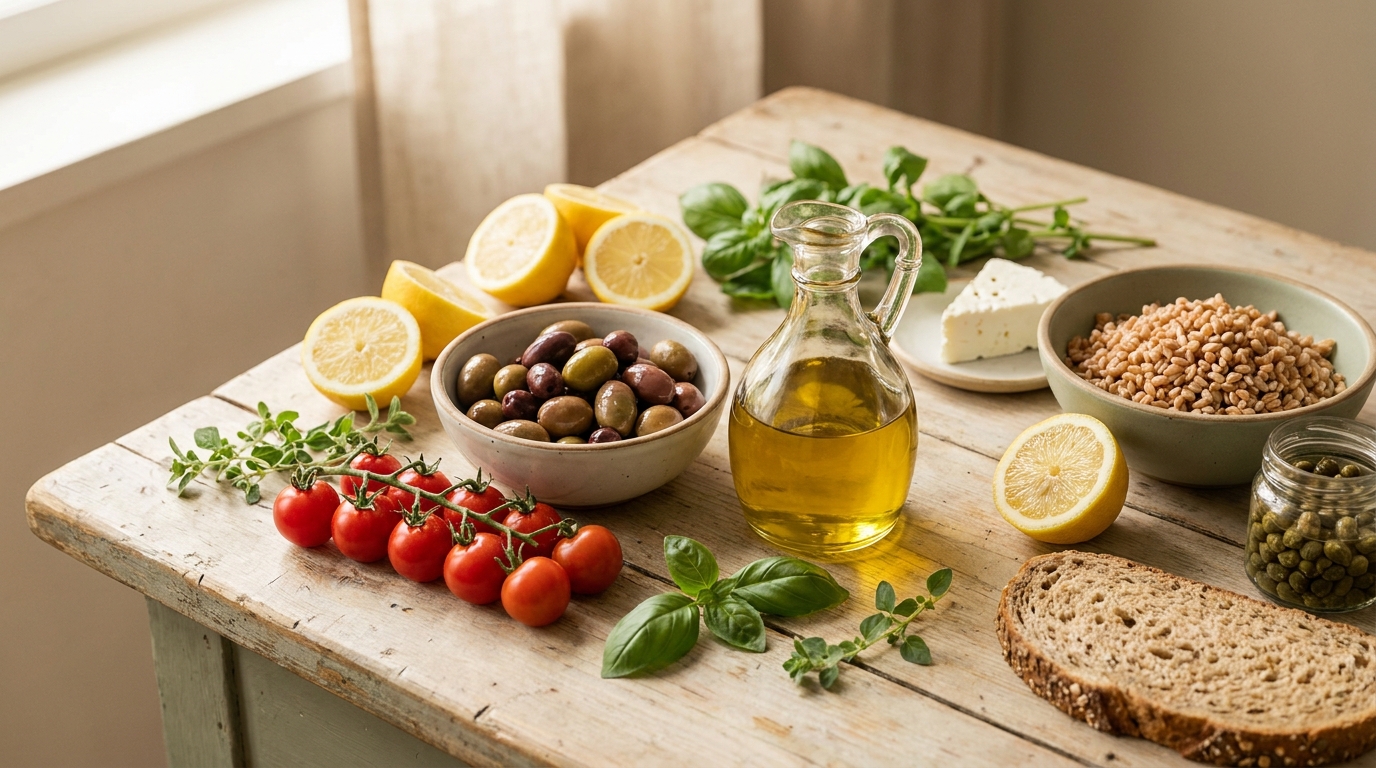
Before rebalancing a recipe, you need a clear picture of what you are rebalancing toward. The Mediterranean diet is usually visualized as a pyramid, with the foods you eat most often at the base.
| Frequency | Foods |
|---|---|
| Every meal | Vegetables, fruits, whole grains, legumes, nuts, seeds, herbs, spices, extra-virgin olive oil |
| Weekly (a few times) | Fish and seafood (especially fatty fish), poultry, eggs, fermented dairy (Greek yogurt, feta, kefir) |
| Monthly or less | Red meat, processed meat, sweets, refined grains |
| Optional, in moderation | Red wine with meals (one glass for women, up to two for men) |
| Always | Water as the primary beverage |
A few principles guide every conversion:
- Olive oil is the default fat. Not butter, not vegetable oil, not lard. Extra-virgin olive oil shows up in nearly every savory recipe.
- Plants outnumber animals on the plate. A Mediterranean meal is mostly vegetables, grains, and legumes, with animal protein as a flavor and texture component rather than the star.
- Fish trumps red meat. Especially fatty fish — salmon, sardines, mackerel, anchovies — loaded with the omega-3s responsible for much of the diet’s heart benefit.
- Whole grains over refined. Farro, bulgur, freekeh, barley, brown rice, whole-wheat pasta, whole-grain bread.
- Fermented dairy in small amounts. Greek yogurt and feta, not American cheese and heavy cream.
- Acid, herbs, and good oil do the flavor work. Lemon, vinegar, garlic, fresh herbs, and olive oil replace the cream-and-butter axis that dominates Western cooking.
Every conversion in this guide is just an application of those principles to one ingredient at a time.
Fat Conversions: Olive Oil Is Your Default
The single most impactful change in any Mediterranean diet recipe conversion is the fat. Switch it, and you have already moved the recipe substantially toward the pattern.
Butter to Olive Oil
For most savory applications — sauteing, roasting, finishing pasta, dressing vegetables — extra-virgin olive oil is a direct, often improved, replacement for butter. The flavor profile shifts from creamy and lactic to grassy, peppery, and slightly fruity. Most cooks find a good olive oil adds more dimension than butter once they get used to it.
| Original | Mediterranean Swap | Ratio | Notes |
|---|---|---|---|
| 1 tbsp butter (sauteing) | 1 tbsp extra-virgin olive oil | 1:1 | Heat to shimmering, not smoking |
| 1 tbsp butter (finishing pasta) | 1.5 tbsp extra-virgin olive oil | Slightly more | Olive oil emulsifies pasta water differently — a little extra helps |
| 1 stick butter (roasting vegetables) | 1/2 cup extra-virgin olive oil | 1:1 by volume, slightly less by weight | Toss vegetables thoroughly |
| 1 tbsp butter (eggs) | 1 tbsp extra-virgin olive oil | 1:1 | Spanish-style olive oil eggs are a revelation |
A note on smoke points. A common myth is that you cannot cook with extra-virgin olive oil because of its smoke point. Modern research shows EVOO is actually one of the most stable cooking oils — its antioxidants make it resistant to oxidation even at higher temperatures. For very high-heat work (deep frying, searing a steak), light or refined olive oil is fine.
When to keep the butter. Butter is not banned in the Mediterranean diet — it is just used sparingly. The milk solids in butter brown in ways oil does not, so for croissants, biscuits, and laminated doughs, keep the butter. For beurre blanc and similar emulsion sauces, convert to an olive-oil-based equivalent (like a vinaigrette-style pan sauce) rather than swapping butter directly.
Vegetable Oil and Lard to Olive Oil
Neutral seed oils (canola, soybean, vegetable) and lard are direct 1:1 swaps for olive oil. Use light or refined olive oil for higher-heat work; use extra-virgin for dressings, finishing, and most sauteing.
| Original | Mediterranean Swap | Ratio |
|---|---|---|
| Vegetable oil (sauteing) | Extra-virgin olive oil | 1:1 |
| Vegetable oil (deep frying) | Light or refined olive oil | 1:1 |
| Vegetable oil (baking, neutral) | Light olive oil | 1:1 |
| Lard (cooking) | Extra-virgin olive oil | 1:1 |
| Lard (pastry) | Cold butter (small amount) or olive oil | 1:1 with technique adjustments |
| Margarine | Olive oil or vegan butter made from olive oil | 1:1 |
Protein Rebalancing: Less Red Meat, More Fish and Legumes
Red meat is not banned, but it is treated as a monthly indulgence rather than a weekly staple. The proteins doing most of the work are fish, seafood, poultry, eggs, and — crucially — legumes, which are one of the most underused ingredients in American cooking.
The trick to protein rebalancing is to stop thinking of meat as the protein and everything else as a side. In Mediterranean cooking, the plate often gets flipped: vegetables, grains, and beans take up most of the real estate, with smaller amounts of fish or chicken layered in.
Red Meat to Fish
Fatty fish is the gold standard. Salmon, sardines, mackerel, anchovies, and tuna are rich in omega-3s, satisfying, and surprisingly versatile.
| Original | Mediterranean Swap | Notes |
|---|---|---|
| Steak | Grilled or seared salmon | Same cooking method, similar fat content |
| Pot roast | Slow-braised tuna or swordfish steaks | Use a tomato-and-olive braising liquid |
| Beef stew | White bean and tuna stew (think Tuscan) | Cannellini beans + canned tuna in olive oil |
| Burger | Salmon burger or tuna burger | Bind with breadcrumbs, lemon zest, and dill |
| Beef tacos | Grilled fish tacos | Mahi, snapper, or even canned sardines |
| Bacon (savory accent) | Anchovies or capers | A few anchovies provide the same salty-umami punch |
Don’t overlook canned options. Anchovies, sardines, and tuna packed in olive oil are pantry staples in Italy, Spain, and Portugal — depth and protein at a fraction of the cost of fresh fish.
Red Meat to Poultry
Chicken and turkey sit firmly in the Mediterranean pattern as a few-times-a-week protein. They cook similarly to red meat and absorb Mediterranean flavors (lemon, garlic, herbs, olive oil) beautifully.
| Original | Mediterranean Swap | Notes |
|---|---|---|
| Ground beef (tacos, pasta) | Ground turkey or ground chicken | Season more aggressively — they are leaner and milder |
| Beef chili | Half ground turkey + half lentils | Get the meaty mouthfeel without the saturated fat |
| Pork chops | Boneless chicken thighs | Higher fat than breasts, more forgiving |
| Pulled pork | Slow-cooked chicken thighs in tomato and oregano | Shredded the same way |
Red Meat to Legumes
This is the move that makes the biggest dent in red meat consumption. Beans and lentils are cheap, shelf-stable, full of fiber and protein, and central to almost every Mediterranean cuisine.
| Original | Mediterranean Swap | Notes |
|---|---|---|
| Ground beef (1 lb) | 1 cup dry lentils, cooked (or 2.5 cups canned) | Brown or green lentils for chili, bolognese |
| Beef chunks (stew) | Chickpeas + diced eggplant | Common North African and Levantine combination |
| Bacon (in soups, pasta) | White beans + a splash of olive oil | Provides the body and richness |
| Meatballs | Lentil-and-walnut “meatballs” or 50/50 lentil-and-turkey meatballs | Bind with egg and breadcrumbs |
| Chicken in salads | Chickpeas or white beans | Adds protein and bulk to grain bowls |
Keeping flavor when you swap to lighter proteins. The most common mistake when you convert recipe to Mediterranean style is under-seasoning the new proteins. Beef and pork carry a lot of flavor on their own. Fish, poultry, and beans need more help. Lean on garlic, lemon, fresh herbs, good olive oil, smoked paprika, anchovy paste, capers, olives, and sun-dried tomatoes. A bowl of lentils with olive oil, lemon, and parsley tastes nothing like a bowl of bland boiled lentils.
Grain Swaps: Whole Grains Are the Default
Mediterranean cuisine is full of grains — they are not avoided, just upgraded. The shift is from refined to whole.
| Original | Mediterranean Swap | Ratio | Notes |
|---|---|---|---|
| White rice | Farro | 1:1 by volume | Nutty, chewy, holds up beautifully in salads |
| White rice | Bulgur | 1:1 by volume | Cooks quickly, perfect for tabbouleh |
| White rice | Brown rice | 1:1 by volume | Familiar, easy starter swap |
| White rice | Freekeh | 1:1 by volume | Smoky, ancient Levantine grain |
| White rice | Barley | 1:1 by volume | Excellent in soups and stews |
| White pasta | Whole-wheat pasta | 1:1 | Sauce it more generously — whole wheat absorbs more |
| White pasta | Chickpea or lentil pasta | 1:1 | Higher protein, good for shorter shapes |
| All-purpose flour (baking) | Whole-wheat flour or 50/50 blend | 1:1 with slight liquid increase | Add 2 tbsp extra liquid per cup |
| White bread | Whole-grain sourdough | 1:1 | Look for “100% whole grain” on the label |
| White flour tortilla | Whole-wheat tortilla or whole-grain flatbread | 1:1 | Or use lavash, pita |
| Cornflakes / sugary cereal | Whole-grain muesli or steel-cut oats | 1:1 | Top with Greek yogurt and fruit |
A note on technique. Whole grains need more liquid and longer cook times than refined grains, and they benefit from a quick toast in olive oil before adding water. As a starting point, add 5-10 minutes of cook time and an extra 1/4 cup of liquid per cup of dry grain.
Dairy Adjustments: Fermented and in Smaller Amounts
The Mediterranean diet is not dairy-free. It is dairy-different. Heavy cream, processed cheese, and large servings of milk are minimized. Fermented dairy in modest amounts — Greek yogurt, kefir, feta, fresh goat cheese, ricotta, Parmigiano — fills in.
Heavy Cream to Greek Yogurt
This is the big one. Heavy cream shows up in pasta sauces, soups, and baked goods, and full-fat Greek yogurt is a remarkably versatile substitute.
| Original | Mediterranean Swap | Notes |
|---|---|---|
| Heavy cream (in soup) | Full-fat Greek yogurt, stirred in off-heat | 1:1, but temper first to prevent curdling |
| Heavy cream (in pasta sauce) | Greek yogurt + reserved pasta water | Mix yogurt with hot pasta water before adding to sauce |
| Sour cream | Greek yogurt | 1:1 direct swap |
| Whipped cream | Whipped Greek yogurt with honey | Lighter but still rich |
| Half and half (coffee) | Whole milk or oat milk | Both fit the pattern in moderation |
| Buttermilk | Greek yogurt thinned with milk or water | 1:1 |
The trick with Greek yogurt is temperature — it splits if you boil it. Stir it in at the end, off the heat, or temper it with a little warm liquid first.
Processed Cheese to Feta and Fresh Cheeses
American cheese and the orange shredded blends do not appear in the Mediterranean pyramid. The cheeses that do are aged, often sheep’s or goat’s milk, and used in smaller amounts where their strong flavor goes a long way.
| Original | Mediterranean Swap | Notes |
|---|---|---|
| Shredded cheddar | Crumbled feta | Use about 60% of the original amount — feta is much saltier and stronger |
| Cream cheese | Whipped feta or labneh | Labneh is strained yogurt, incredibly creamy |
| Mozzarella (on pizza) | Fresh mozzarella in smaller amount + crumbled feta | Fresh, not the rubbery shredded kind |
| Parmesan (on pasta) | Real Parmigiano-Reggiano, finely grated | Already Mediterranean — just use the real thing |
| American cheese (sandwich) | Fresh goat cheese or feta | Combine with roasted vegetables |
| Ricotta | Ricotta (already Mediterranean) | Keep, but use whole-milk fresh ricotta |
Milk
Milk is fine in moderation. Whole milk in coffee, a glass with a meal, milk in baking — all fit. The shift is away from gallons-per-week consumption and toward fermented forms (yogurt, kefir) for most of your dairy intake.
Sweetener Adjustments: Less Is More
The Mediterranean diet is striking in its near-absence of added sugar. Dessert is usually fresh fruit, sometimes drizzled with honey, occasionally a piece of dark chocolate or a small baked good for special occasions. The constant background sweetness of American cooking — sugar in bread, in pasta sauce, in salad dressing — is largely missing.
| Original | Mediterranean Swap | Ratio | Notes |
|---|---|---|---|
| White sugar (baking) | Honey | 3/4 cup honey per 1 cup sugar | Reduce other liquid by 2 tbsp per cup |
| White sugar (sweetening) | Mashed dates or date syrup | Equal sweetness, more body | Great in smoothies, oatmeal |
| Brown sugar | Honey + a pinch of molasses | 3/4 cup + 1 tsp molasses per 1 cup | Or just honey |
| Maple syrup | Honey | 1:1 | Both are minimally processed liquid sweeteners |
| Sweetened beverages | Water + lemon, sparkling water, or unsweetened tea | N/A | The Mediterranean default beverage is water |
| Dessert (general) | Fresh fruit + a small piece of dark chocolate | N/A | Or fruit drizzled with honey and Greek yogurt |
The deeper conversion is not just substituting one sweetener for another, but reducing total added sugar and letting fruit become the primary sweet thing in your day.
Vegetable Density: Add 50% More
Here is a rule of thumb that will Mediterraneanize almost any recipe: take the vegetable amount called for and add 50% more. Most American recipes are dramatically under-vegetabled by Mediterranean standards. A pasta dish with a cup of vegetables becomes a cup and a half. A stew with two cups becomes three.
Concrete techniques to boost vegetable density:
- Double the vegetables in pasta and grain dishes. A bolognese that calls for one onion, one carrot, one stalk of celery? Use two of each, and add zucchini, mushrooms, and spinach at the end.
- Add a salad as a default side. Even when the main has vegetables. Two minutes, changes the meal.
- Wilt leafy greens into eggs, pasta, soups, and stews. Spinach, arugula, kale, chard — they cook down to nothing and add huge nutritional density.
- Use tomatoes liberally. Fresh in summer, canned (San Marzano if you can find them) the rest of the year.
- Add olives, capers, and sun-dried tomatoes for instant flavor. Briny, intense, and they let you use less salt and meat without sacrificing depth.
- Build the meal around the vegetable. Instead of “what protein with what vegetable side,” ask “what vegetable, prepared how, with what protein on the side.”
Herbs and Flavor Strategy: Acid and Brightness Over Cream and Richness
If one shift ties all of these conversions together, it is the change in flavor strategy. Western cooking — especially American and French-influenced cooking — often builds flavor through richness. Cream sauces, butter mounts, melted cheese, slow-rendered fats. Delicious, but calorically dense and they crowd out the lighter, brighter flavors of the Mediterranean.
Mediterranean cooking builds flavor through a different toolkit:
- Fresh herbs, used generously. Not as garnish — as ingredient. Basil, parsley, mint, dill, oregano, thyme, rosemary. A whole cup of chopped parsley is normal in tabbouleh.
- Garlic, in real quantities. Three or four cloves, not one. Slow-sauteed in olive oil for sweetness, or raw and pounded into a vinaigrette for sharpness.
- Lemon — juice and zest. Acid wakes up everything. A squeeze on roasted vegetables, fish, grain bowls, and yogurt sauces does the work a pat of butter would do in a French recipe.
- Vinegar. Red wine, white wine, sherry, balsamic. A splash in a stew or dressing brightens the whole dish.
- Good olive oil as a finishing ingredient. Drizzled at the end, off the heat — a flavor element, not just a cooking medium.
- Spices like cumin, coriander, smoked paprika, sumac, za’atar, fennel seed. They do enormous work in eastern Mediterranean and North African dishes.
- Briny accents. Olives, capers, anchovies, preserved lemon, feta — concentrated bursts of savory complexity.
When you convert a cream-based dish to Mediterranean, you are trading richness for brightness. A fettuccine alfredo becomes a lemon-and-olive-oil pasta with herbs, garlic, and grated parmesan. Still satisfying — just gets there a different way.
Sample Conversions: Three Mini Case Studies
Theory is helpful, but conversions click when you see them applied. Here are three common American dishes converted to Mediterranean versions that deliver the same satisfaction.
1. American Beef Chili → Mediterranean White Bean and Tuna Stew
Original: 1.5 lb ground beef, onion, green bell pepper, 3 cloves garlic, 2 cans diced tomatoes, 1 can kidney beans, chili powder/cumin/paprika, vegetable oil. Topped with cheddar and sour cream.
Mediterranean conversion:
- 2 cans tuna packed in olive oil, drained (oil reserved)
- 1 yellow onion, diced
- 1 fennel bulb, diced (in addition to or instead of bell pepper)
- 6 cloves garlic
- 2 cans San Marzano tomatoes, crushed
- 2 cans cannellini (white) beans
- 2 cans chickpeas
- 1 tbsp smoked paprika, 1 tsp cumin, 1 tsp dried oregano, pinch of red pepper flakes
- 3 tbsp extra-virgin olive oil
- Stir in: a handful of pitted Kalamata olives, 2 tbsp capers, large handful of chopped parsley
- Toppings: crumbled feta, lemon wedges, drizzle of olive oil
The result is a hearty, brothy bean stew with meatiness from the tuna and depth from the olive oil, herbs, and brine — the same comfort-food note as chili, squarely in the Mediterranean pattern.
2. Fettuccine Alfredo → Lemon-Olive-Oil Pasta with Grilled Chicken and Arugula
Original: 1 lb fettuccine, 1 cup heavy cream, 1 stick butter, 1.5 cups grated parmesan, 2 cloves garlic, black pepper.
Mediterranean conversion:
- 1 lb whole-wheat fettuccine or linguine
- 1/2 cup extra-virgin olive oil
- 5 cloves garlic, thinly sliced
- Zest and juice of 2 lemons
- 1/2 cup grated Parmigiano-Reggiano (the real thing, used as a flavor accent)
- 1 lb chicken thighs, marinated in olive oil, lemon, oregano, and grilled, sliced
- 4 cups baby arugula, tossed in at the end
- 1/2 cup reserved pasta water for emulsifying
- Salt, cracked black pepper, red pepper flakes
- Finish with a drizzle of olive oil and extra parmesan
The cream-and-butter richness becomes a silky garlic-and-olive-oil emulsion brightened by lemon. Arugula adds peppery freshness and bumps the vegetable content. The parmesan stays — just less of it, used as flavor rather than as the body of the sauce.
3. Ranch-Dressed Iceberg Salad → Lemon-Olive-Oil Vinaigrette with Feta and Olives
Original: Iceberg lettuce, cherry tomatoes, shredded cheddar, white-bread croutons, bottled ranch dressing.
Mediterranean conversion:
- A mix of romaine, baby spinach, and arugula
- Cherry tomatoes, halved
- Cucumber, diced
- Red onion, thinly sliced and rinsed in cold water
- 1/4 cup pitted Kalamata olives
- 1/2 cup crumbled feta
- Whole-grain croutons (sourdough, toasted in olive oil)
- Vinaigrette: 1/4 cup extra-virgin olive oil, juice of 1 lemon, 1 tsp Dijon, 1 small clove garlic minced, pinch of dried oregano, salt, pepper
The cheese-and-creamy-dressing salad becomes a Greek-inspired bowl with much higher vegetable density, fermented dairy in moderation, and an acid-and-olive-oil dressing you will probably start making in big batches.
The Easy Way: Let AI Handle the Conversion
By now you have a working theory of Mediterranean conversion: shift the fats toward olive oil, the proteins toward fish and legumes, the grains toward whole, the dairy toward fermented and small amounts, and the flavor strategy toward acid and herbs over cream and butter.
But here is the catch. Mediterranean conversion is more nuanced than simple swap-this-for-that, because it is a rebalancing rather than a substitution. You cannot just swap every stick of butter for olive oil and call it done. You have to look at the whole dish — decide what to swap, what to keep, what to reduce, what to add more of. You have to know that the cream in this sauce can become Greek yogurt but the cream in that pastry probably needs to stay. It is real cognitive work, every time.
That is exactly the problem Re-Whisk was built to solve. Re-Whisk is a free Chrome extension that uses AI food science to convert any web recipe to Mediterranean style (along with vegan, keto, gluten-free, dairy-free, and dozens of other variants) with one click. It does not do naive find-and-replace. It analyzes the role each ingredient plays, decides what to swap and what to rebalance, and adjusts quantities and cooking instructions to match.
Found a creamy chicken pasta recipe? Re-Whisk will swap the heavy cream for a Greek-yogurt-and-pasta-water emulsion, bump up the garlic, add lemon zest, suggest whole-wheat or chickpea pasta, double the vegetables, and recommend a parmesan finish — all while you are still on the recipe page.
Mediterranean Conversion Cheat Sheet
A quick-reference table for the most common swaps when you convert a recipe to Mediterranean style.
| Category | Original | Mediterranean Swap | Ratio / Notes |
|---|---|---|---|
| Fat | Butter (sauteing) | Extra-virgin olive oil | 1:1 |
| Fat | Butter (finishing) | Extra-virgin olive oil | 1.5:1 |
| Fat | Vegetable oil | Extra-virgin or light olive oil | 1:1 |
| Fat | Lard | Extra-virgin olive oil | 1:1 |
| Fat | Margarine | Olive oil | 1:1 |
| Protein | Ground beef (chili, pasta) | 50/50 ground turkey + lentils | Match by volume |
| Protein | Steak | Salmon or tuna steak | Match by weight |
| Protein | Pork chops | Boneless chicken thighs | Match by weight |
| Protein | Beef stew chunks | White beans + chickpeas | 2.5 cups cooked beans per 1 lb beef |
| Protein | Bacon | Anchovies or capers (small amount) | A few fillets per 4 strips |
| Protein | Chicken breast | Chicken thighs (when richness needed) | 1:1 |
| Grain | White rice | Farro, bulgur, freekeh, or barley | 1:1 by volume, more liquid + time |
| Grain | White pasta | Whole-wheat or chickpea pasta | 1:1 |
| Grain | All-purpose flour | Whole-wheat flour or 50/50 blend | 1:1, add 2 tbsp liquid per cup |
| Grain | White bread | 100% whole-grain sourdough | 1:1 |
| Grain | Cornflakes / sugary cereal | Steel-cut oats or muesli | Top with Greek yogurt + fruit |
| Dairy | Heavy cream (savory) | Full-fat Greek yogurt | 1:1, add off-heat |
| Dairy | Sour cream | Greek yogurt | 1:1 |
| Dairy | Cream cheese | Whipped feta or labneh | 1:1 |
| Dairy | Shredded cheddar | Crumbled feta | Use 60% of original amount |
| Dairy | American cheese | Fresh goat cheese | Smaller amount, more flavor |
| Dairy | Buttermilk | Greek yogurt thinned with water | 1:1 |
| Sweetener | White sugar | Honey | 3/4 cup per 1 cup, reduce liquid by 2 tbsp |
| Sweetener | Brown sugar | Honey + pinch of molasses | 3/4 cup per 1 cup |
| Sweetener | Maple syrup | Honey | 1:1 |
| Sweetener | Dessert (general) | Fresh fruit + dark chocolate or honey-drizzled yogurt | N/A |
| Vegetables | Recipe vegetable amount | Same + 50% more | Add leafy greens, double aromatics |
| Flavor | Cream/butter for richness | Olive oil + lemon + fresh herbs | Adjust to taste |
| Flavor | Bottled dressing | Olive oil + lemon or vinegar + Dijon + garlic | 3:1 oil to acid |
| Flavor | Salt-only seasoning | Salt + herbs + acid + garlic | Build in layers |
Putting It All Together
Mediterranean diet recipe conversion is not about giving things up. It is about gently shifting the balance of what you cook toward a pattern that tastes great, makes you feel good, and happens to be the most-studied diet for long-term health. You are not removing joy — you are trading some kinds of richness for other kinds of brightness, more vegetables for less meat, whole grains for refined ones.
Start small. Switch to olive oil for everything you used to do with butter or vegetable oil. Add a salad as a default with dinner. Replace one weekly red-meat meal with fish and another with a bean dish. Try farro instead of rice. Each move is small on its own, and together they move your cooking solidly into the Mediterranean pattern.
Once those baseline shifts are habitual, the rest happens naturally. You will reach for lemon and herbs without thinking, double the vegetables by reflex, and find the cream-and-butter dishes you used to crave start to feel a little heavy. That is the Mediterranean pattern settling in — not as a diet you are following, but as the way you cook.