How to Make Any Recipe Low-FODMAP
How to Make Any Recipe Low-FODMAP
You found a recipe that looks perfect. Roasted chicken with garlic, onion, lemon, and white beans. A creamy mushroom pasta. A fruit salad that calls for apples, pears, and watermelon. Then you remember — you are on a low-FODMAP diet, and almost every “fresh and healthy” ingredient on that list is exactly the kind of food that sets your gut off.
That is the unique cruelty of low-FODMAP cooking. With most special diets, the off-limits ingredients are easy to spot. Vegan? No animal products. Gluten-free? No wheat. Keto? No carbs. But FODMAPs are scattered through the foods we have been told our entire lives are good for us — garlic, onion, apples, pears, beans, lentils, milk, honey, mushrooms, cauliflower, even an innocent slice of watermelon. The “healthy” produce aisle suddenly becomes a minefield, and the recipe blogs you used to trust read like a list of triggers.
The good news is that almost any recipe can be adapted. The science behind low-FODMAP swaps is well-documented, and once you understand the categories — and especially how to handle the garlic-and-onion problem — most dishes are surprisingly close to their original form. This guide will walk you through how to make a recipe low-FODMAP from end to end: the substitutions, the reasoning, the hidden traps in packaged foods, and the one shortcut that handles all of it for you.
What FODMAPs Actually Are
FODMAPs is an awkward acronym, but it is worth knowing what it stands for. Fermentable Oligosaccharides, Disaccharides, Monosaccharides, And Polyols. These are short-chain carbohydrates that the small intestine struggles to absorb. When they reach the large intestine intact, gut bacteria ferment them — producing gas, drawing in water, and triggering the bloating, pain, and bowel changes that people with IBS know all too well.
Each letter represents a different type of carbohydrate:
- Oligosaccharides — fructans (in wheat, garlic, onion) and galacto-oligosaccharides or GOS (in beans, lentils, chickpeas)
- Disaccharides — lactose (in milk, soft cheeses, yogurt)
- Monosaccharides — excess fructose (in apples, pears, mango, honey, high-fructose corn syrup)
- Polyols — sorbitol and mannitol (in stone fruits, mushrooms, cauliflower) and added sugar alcohols (xylitol, maltitol, isomalt)
The low-FODMAP diet was developed by researchers at Monash University in Australia, and Monash remains the global authority on which foods contain which FODMAPs and at what threshold. Their app and certification program are the most reliable references when you are unsure about a specific ingredient.
It is also important to remember that the low-FODMAP diet is not meant to be a forever diet. It is structured in three phases: elimination (typically 2-6 weeks of strict avoidance to calm symptoms), reintroduction (systematically testing each FODMAP group to identify your personal triggers), and personalization (a long-term, less restrictive eating pattern based on what you actually react to). This guide focuses on the elimination phase, which is where the substitution work matters most. Once you finish reintroduction, you will likely be able to add many foods back. If you are starting out, consider working with a registered dietitian who specializes in FODMAPs — they can keep the diet from becoming more restrictive than it needs to be.
The High-FODMAP Offenders
Before we get into swaps, here is a quick map of the foods you are most likely to encounter in a typical recipe that need replacing.
Alliums and high-fructan vegetables
- Garlic (any amount)
- Onion (white, yellow, red, shallots)
- Leek bulbs
- Spring onion bulbs (white parts)
- Cauliflower
- Mushrooms (most varieties)
- Asparagus
- Snow peas
- Artichoke
Grains
- Wheat (bread, pasta, flour, couscous, bulgur)
- Rye
- Barley
- Large servings of whole-grain bread products
Legumes
- Most dried beans (black, kidney, navy, pinto)
- Soybeans (whole, edamame in larger portions)
- Lentils in larger portions
Fruit
- Apples
- Pears
- Mango
- Watermelon
- Cherries
- Peaches and nectarines
- Plums and prunes
- Dried fruit in general
Dairy
- Cow’s, sheep’s, and goat’s milk
- Soft cheeses (ricotta, cottage cheese, cream cheese)
- Yogurt (regular)
- Ice cream
- Sweetened condensed milk
Sweeteners
- Honey
- Agave nectar
- High-fructose corn syrup
- Sorbitol, mannitol, xylitol, isomalt, maltitol
Other
- Cashews
- Pistachios
- Inulin and chicory root (added to many “healthy” packaged foods)
That is a long list — but every one of these has a low-FODMAP counterpart, and many of them are simply about portion size rather than total avoidance.
The Garlic and Onion Problem (and How to Solve It)
If there is one thing that makes people give up on low-FODMAP cooking, it is garlic and onion. They are in nearly every savory recipe ever written. They are the base of mirepoix, sofrito, holy trinity, and almost every curry, stew, and pan sauce. Removing them feels like cooking with one hand tied behind your back.
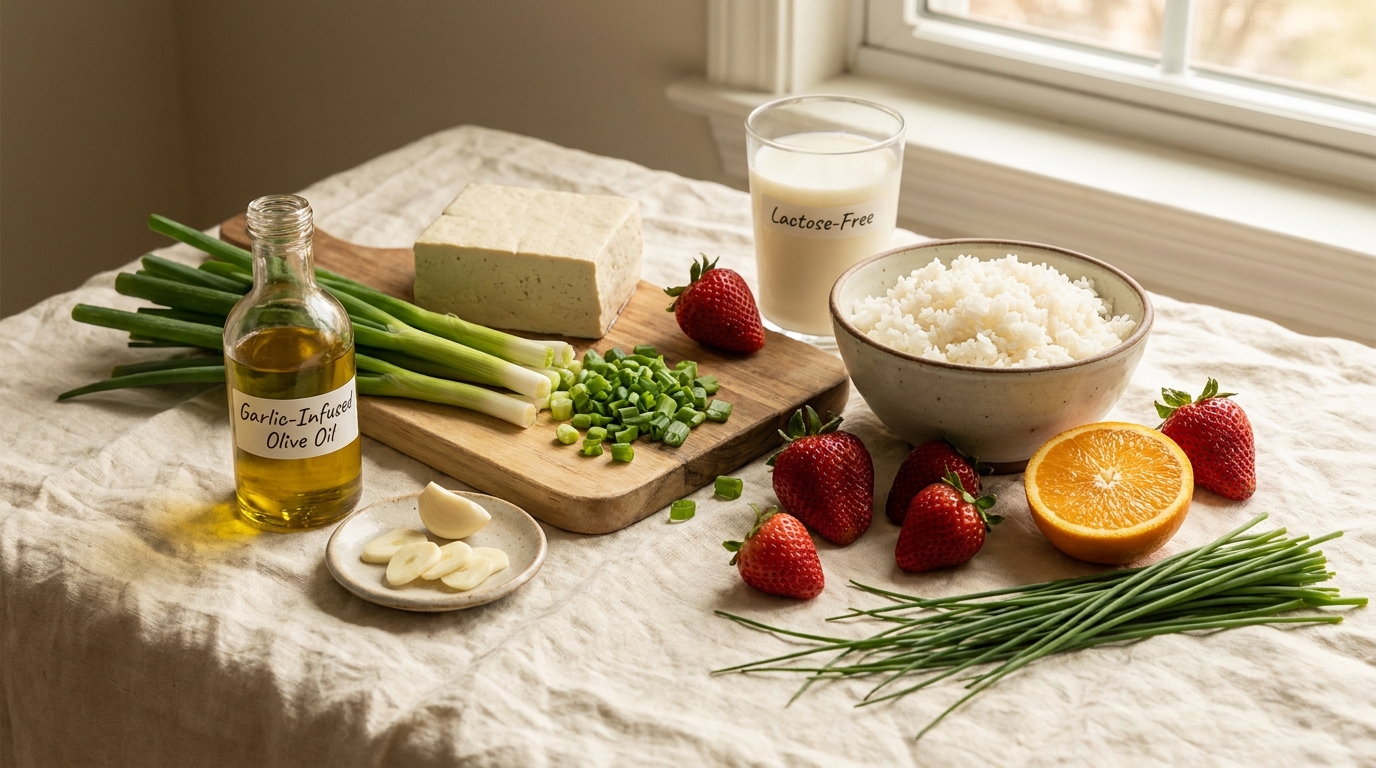
Here is the key insight that changes everything: the FODMAPs in garlic and onion (fructans) are water-soluble, not oil-soluble. That means you can extract the flavor compounds into oil without the fructans coming along. Garlic-infused olive oil — store-bought or homemade — gives you the full flavor of garlic with essentially no FODMAP load, as long as you strain out the solids.
The same principle applies to certain plant parts. The green tops of scallions and leeks contain almost no fructans. The fructans concentrate in the white bulbs. So you can finely slice the dark green parts of scallions and use them anywhere you would use chopped onion — sauteed at the start of a dish, sprinkled on top, or stirred into eggs.
| You Want the Flavor Of… | Use This Instead | Notes |
|---|---|---|
| Garlic (sauteed in oil) | Garlic-infused olive oil | 1-2 tbsp replaces 2-3 cloves; add at the end for stronger flavor |
| Garlic (raw, in dressings) | Garlic-infused olive oil + a pinch of asafoetida | Asafoetida (hing) is the secret weapon — pungent, alliumlike |
| Onion (sauteed base) | Green tops of scallions or leek leaves | Slice thin; saute briefly so they do not burn |
| Onion (raw, in salads) | Chives or scallion greens | Adds the sharp bite without the fructans |
| Onion powder | Asafoetida (a tiny pinch) | A quarter-teaspoon goes a long way |
| Caramelized onion | Slow-cooked leek greens with a touch of sugar | Will not get quite as deep, but close |
| Shallot | Garlic-infused olive oil + chives | Use both for the layered flavor |
A note on asafoetida (hing): This is a resin from a fennel relative used heavily in Indian cooking. It smells aggressive raw — almost sulfurous — but bloomed in hot oil for a few seconds it transforms into a savory, allium-like flavor. A pinch (less than 1/8 teaspoon) replaces a clove of garlic in most recipes. Make sure to buy a brand that uses rice flour as a filler rather than wheat flour.
Grain and Starch Swaps
Wheat is high in fructans, but the issue is dose-dependent. Small servings of certain wheat-based foods (like a slice of long-fermented sourdough) can be tolerated. For the elimination phase, though, it is easier to swap wheat out entirely.
| High-FODMAP Grain | Low-FODMAP Swap | Notes |
|---|---|---|
| Wheat pasta | Rice pasta, corn pasta, quinoa pasta | Most gluten-free pastas work; check labels for inulin |
| Wheat bread | Sourdough spelt (true long-fermented) or low-FODMAP certified bread | The fermentation breaks down most of the fructans |
| Wheat flour (baking) | Oat flour, rice flour, gluten-free 1:1 flour blend | Gluten-free flours often need extra binder |
| Couscous, bulgur, farro | Quinoa, rice, polenta | Quinoa is a complete protein and very gentle |
| Barley | Rice or buckwheat | Buckwheat is naturally gluten-free despite the name |
| Rye | Sourdough spelt or rice-based bread | Same principle as wheat |
| Breakfast cereal (wheat-based) | Rice flakes, cornflakes (no HFCS), oats (1/2 cup serving) | Watch for added inulin and dried fruit |
A critical clarification: gluten-free is not the same as low-FODMAP. A gluten-free pasta made from chickpea flour is still high in GOS. A gluten-free bread sweetened with apple juice concentrate is high in fructose. A “healthy” gluten-free granola loaded with cashews and dried apple is a FODMAP bomb. Always read the ingredient list — a product can be gluten-free and still trigger you, or it can be conventional wheat-free and still problematic.
Oats are tolerated in moderate portions (about 1/2 cup of rolled oats), and quinoa, rice, and corn-based products are reliably safe in normal serving sizes.
Dairy Swaps
The disaccharide that causes problems in dairy is lactose. Hard, aged cheeses lose almost all their lactose during the aging process — which is why a piece of cheddar or parmesan is fine, but a scoop of cottage cheese is not. This makes dairy easier to navigate than people expect.
Use freely (low-lactose or lactose-free):
- Lactose-free milk (cow’s milk with the lactase enzyme added — same nutrition, no lactose)
- Hard aged cheeses: cheddar, parmesan, swiss, gruyere, manchego, pecorino
- Lactose-free yogurt
- Butter (very low lactose; tolerated in normal amounts)
- Brie and camembert in small portions (about 1 oz)
- Feta in small portions
Use in moderation:
- Almond milk (1 cup serving)
- Rice milk (1/2 cup serving — higher in carbs)
- Macadamia milk
- Coconut milk from a carton (1/2 cup)
Avoid during elimination:
- Regular cow’s, sheep’s, or goat’s milk
- Soft cheeses: ricotta, cottage cheese, cream cheese, mascarpone
- Regular yogurt
- Ice cream (lactose plus often high-fructose corn syrup)
- Sweetened condensed milk
- Soy milk made from whole soybeans (soy milk made from soy protein is fine — read the label)
A practical tip for cream-based recipes: lactose-free heavy cream and lactose-free half-and-half are now widely available and behave identically to their regular counterparts in cooking. They are the easiest swap for anything from alfredo sauce to ice cream.
Fruit and Vegetable Swaps
This is where the substitution table earns its keep. Many recipes call for produce that happens to be high-FODMAP when an almost identical low-FODMAP alternative exists.
| High-FODMAP Produce | Low-FODMAP Swap | Notes |
|---|---|---|
| Onion (white/yellow/red) | Scallion greens or chives | About 1/4 cup chopped greens per onion |
| Garlic | Garlic-infused olive oil | 1 tbsp per 2 cloves |
| Apple | Orange, strawberries, or firm banana | Strawberries pair well in baked goods |
| Pear | Cantaloupe, kiwi, or pineapple | Kiwi is also great for digestion |
| Watermelon | Cantaloupe or honeydew (small portion) | Limit honeydew to about 1/2 cup |
| Mango | Pineapple or papaya | Papaya is naturally low-FODMAP |
| Cherries | Grapes or strawberries | Stone fruits are nearly all polyol-heavy |
| Peach / nectarine | Orange or mandarin | Citrus is reliably safe |
| Cauliflower | Broccoli florets (3/4 cup) or green beans | Use florets only, not stems, for broccoli |
| Mushrooms (button, portobello) | Oyster mushrooms or canned champignons (drained) | Canning leaches out most of the mannitol |
| Asparagus | Green beans or zucchini | Zucchini is a great all-purpose swap |
| Snow peas | Green beans or sugar snap peas (small portion) | Limit sugar snaps to about 5 pods |
| Sweet potato | Regular potato, parsnip, or 1/2 cup serving of sweet potato | Sweet potato is fine in small portions |
| Avocado (large amount) | 1/8 of a whole avocado | Sorbitol-rich; small portions only |
| Artichoke | Hearts of palm | Similar texture, very low-FODMAP |
| Sun-dried tomato | Fresh tomato or roasted red pepper | Sun-drying concentrates fructans |
| Beetroot (more than 2 slices) | Carrot or red bell pepper | Two pickled slices are fine |
A few helpful baseline vegetables that work nearly anywhere: carrots, zucchini, bell peppers (red and green), spinach, kale, lettuce, cucumber, eggplant, green beans, bok choy, and tomatoes are all safely low-FODMAP in normal serving sizes. Build your “trusted shortlist” around these.
Sweetener Guidance
Sweeteners are sneaky because so many “healthy” alternatives to sugar are actually high-FODMAP. Honey is high in excess fructose. Agave is the worst offender for fructose load. And the sugar alcohols you find in keto and “no sugar added” products — sorbitol, mannitol, xylitol, maltitol, isomalt — are explicitly the “P” in FODMAP.
Use freely:
- Table sugar (sucrose)
- Brown sugar
- Glucose / dextrose
- Maple syrup (up to 2 tablespoons per serving)
- Stevia (pure)
- Rice malt syrup
- Pure glucose syrup
Avoid:
- Honey
- Agave nectar
- High-fructose corn syrup
- Sorbitol, mannitol, xylitol, maltitol, isomalt, lactitol
- Coconut sugar in large amounts (small amounts okay)
- Fruit juice concentrates (especially apple and pear)
The simplest rule: if a recipe calls for honey, swap maple syrup 1:1. If it calls for agave, use sugar dissolved in a little warm water. If a “sugar-free” product lists anything ending in “-itol” or “-ose” beyond glucose and dextrose, put it back on the shelf.
Bean and Legume Substitutes
Beans and lentils are tough because they are loaded with GOS (galacto-oligosaccharides) — a type of fructan that humans cannot digest. The good news: GOS is water-soluble, so the canning and rinsing process leaches a lot of it out. That makes some legumes workable in smaller portions.
Tolerated in measured portions:
- Canned chickpeas, drained and rinsed (1/4 cup per serving)
- Canned lentils, drained and rinsed (1/2 cup per serving)
- Canned butter beans, drained and rinsed (1/4 cup per serving)
- Firm tofu (3/4 cup) — pressed and drained
- Tempeh (1/2 cup)
- Edamame (1/4 cup pods)
Avoid during elimination:
- Most dried beans (black, kidney, navy, pinto, cannellini)
- Soybeans (whole)
- Silken tofu (higher in FODMAPs than firm)
- Hummus (large portions; small amounts okay)
- Refried beans
The trick when adapting a bean-heavy recipe: replace half or more of the volume with another protein or vegetable. A chili that calls for two cans of black beans can become a chili with 1/4 cup of canned lentils plus extra ground beef, diced zucchini, and bell peppers. A white bean soup can become a chickpea-and-potato soup with a smaller portion of beans.
Firm tofu is an underrated weapon here — it is reliably low-FODMAP, takes any flavor you give it, and works as a stand-in for everything from chicken to beans to ricotta.
Hidden FODMAPs in Packaged Foods
This is where many people on the elimination diet get blindsided. A “natural” granola bar that should be safe contains chicory root for fiber. A protein shake lists inulin for prebiotic benefits. A salad dressing has onion powder buried in the ingredient list. Even foods that look spotless on the front of the package can quietly contain high-FODMAP additives.
Watch for these on labels:
- Onion powder, garlic powder, onion salt, garlic salt — extremely common in seasonings, broths, marinades, sausages, soups, and dressings
- Inulin / chicory root / chicory root fiber — added to “healthy” bars, yogurts, ice creams, and protein powders for fiber
- Fructo-oligosaccharides (FOS) — listed as a prebiotic; same family as fructans
- Galacto-oligosaccharides (GOS) — sometimes added to dairy products
- High-fructose corn syrup — in sodas, candies, sauces, and many condiments
- Apple or pear juice concentrate — used as a “natural” sweetener in granola bars, kid’s snacks, fruit purees
- “Natural flavors” — often vague, but in savory products this frequently includes onion or garlic extract; when in doubt, contact the manufacturer
- Polydextrose — a fiber additive that can trigger symptoms
- Sorbitol, mannitol, xylitol, maltitol, isomalt — in sugar-free gum, mints, ice cream, and “diet” products
- Whey protein concentrate — higher in lactose than whey isolate; choose isolate
Stocks and broths are particularly notorious. Almost every commercial chicken broth includes onion. Look for low-FODMAP certified broths (Fody Foods makes one) or make your own with carrots, celery, herbs, and the green tops of leeks.
The Easy Way: Let AI Handle the Conversion
By now you can see why low-FODMAP is uniquely hard among special diets. Vegan cooking has clear “no animal” rules. Gluten-free is essentially “no wheat, rye, or barley.” But to make a recipe low-FODMAP, you have to think about every ingredient — the fructans hiding in the garlic, the lactose in the cream, the GOS in the beans, the polyols in the cherries, and the FOS quietly added to your “healthy” stock — and then you have to choose substitutes that match each one without breaking the dish.
That is a lot to keep in your head every time you find a recipe online. And the substitutions have to be contextual: garlic-infused oil works at the start of a saute but does not work in a raw aioli, scallion greens replace onion in some dishes but not all, canned lentils need portion-control while firm tofu does not.
Re-Whisk is a free Chrome extension built specifically to handle this kind of intelligent conversion. It uses AI food science to read any web recipe and convert it to your dietary preference — low-FODMAP, gluten-free, keto, vegan, dairy-free, and more — in a single click. It does not just delete the high-FODMAP ingredients. It analyzes what each ingredient is doing in the recipe, picks the right substitute for that specific role, and adjusts portions where needed.
Found a recipe with sauteed garlic, onion, and white beans? Re-Whisk swaps in garlic-infused olive oil, the green parts of scallions, and a measured 1/4 cup of canned, rinsed chickpeas — then adjusts the rest of the recipe to match the new flavor balance. Reading a creamy mushroom pasta? It swaps the mushrooms for canned champignons, the cream for lactose-free cream, and the wheat pasta for rice pasta, all in place on the page you are already viewing.
Low-FODMAP Substitution Cheat Sheet
A consolidated quick reference for when you need to make a recipe low-FODMAP at a glance.
| High-FODMAP Ingredient | Low-FODMAP Swap | Ratio / Notes |
|---|---|---|
| Garlic (cloves) | Garlic-infused olive oil | 1 tbsp per 2 cloves |
| Garlic powder | Asafoetida (hing) | A pinch (1/8 tsp) per 1 tsp garlic powder |
| Onion (chopped) | Scallion greens or leek leaves | 1/4 cup greens per small onion |
| Onion powder | Asafoetida + chives | Small pinch goes far |
| Shallot | Chives + garlic-infused oil | Combine for layered flavor |
| Wheat flour | Gluten-free 1:1 flour or oat flour | 1:1 swap; may need extra binder |
| Wheat pasta | Rice or corn pasta | 1:1; check label for inulin |
| Wheat bread | Long-fermented sourdough spelt | 1 slice per serving |
| Cow’s milk | Lactose-free milk | 1:1 |
| Heavy cream | Lactose-free heavy cream | 1:1 |
| Yogurt | Lactose-free yogurt | 1:1 |
| Cream cheese | Lactose-free cream cheese or aged cheese spread | 1:1 |
| Soft cheese (ricotta) | Firm tofu, blended with lemon | 1:1 by volume |
| Hard cheese (parmesan, cheddar) | No swap needed | Naturally low-lactose |
| Apple | Orange or strawberries | Match by volume |
| Pear | Kiwi or cantaloupe | 1:1 |
| Mango | Pineapple or papaya | 1:1 |
| Watermelon | Cantaloupe | 1:1 (limit to 1 cup) |
| Honey | Maple syrup | 1:1 (up to 2 tbsp per serving) |
| Agave | Table sugar | 1:1 (dissolve in warm water if liquid needed) |
| HFCS | Maple syrup or table sugar | 1:1 |
| Black beans / kidney beans | Canned, rinsed chickpeas or lentils | 1/4 to 1/2 cup per serving |
| Lentils (dried) | Canned, drained lentils | 1/2 cup per serving |
| Whole soybeans / silken tofu | Firm tofu | 1:1 (press and drain) |
| Cauliflower | Broccoli florets | 3/4 cup florets (no stems) |
| Mushrooms (fresh) | Canned champignons (drained) or oyster mushrooms | 1:1 |
| Asparagus | Green beans or zucchini | 1:1 |
| Avocado (1/2) | 1/8 avocado | Limit portion only |
| Cashews | Macadamia nuts or walnuts | 1:1 |
| Chicken broth (commercial) | Low-FODMAP certified broth or homemade | 1:1 |
Putting It All Together
Learning to make a recipe low-FODMAP is a skill that compounds quickly. The first few weeks of the elimination phase feel like detective work — checking labels, looking up substitutions, second-guessing every ingredient. But within a month, you have a mental map: garlic becomes garlic oil, onion becomes scallion greens, milk becomes lactose-free, beans become a measured 1/4 cup, and most fruit gets swapped for citrus or strawberries.
The most important thing to remember is that the elimination phase is temporary. Once your symptoms have settled, the reintroduction phase will tell you which FODMAPs you actually react to and at what dose. Most people end up tolerating far more than the strict elimination list allows. For personalized guidance through reintroduction — and to make sure you are not staying on the restrictive phase longer than necessary — talk to a registered dietitian who specializes in FODMAPs.
Until then, the substitutions in this guide will get you through almost any recipe you find online. And when you do not feel like running through the checklist yourself, Re-Whisk can do the conversion for you in a single click — leaving you with the part of cooking that was supposed to be enjoyable in the first place.